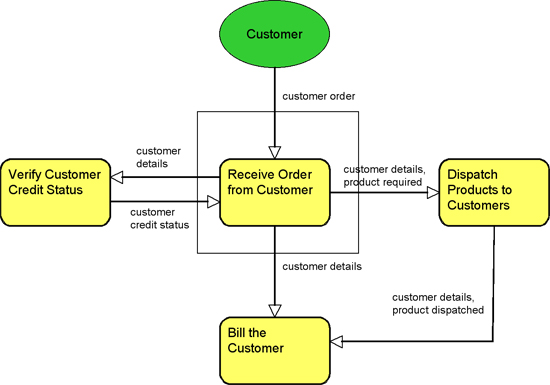
All Business Functions on an Information Flow Diagram (IFD) come from the Function Catalogue.
In older modeling methods, diagrams showing information flow were incorrectly termed Data Flow Diagrams or DFDs and were often incorrectly used to model Business Processes – with unfortunate consequences. This is a practice to be avoided at all costs.
Information Flow Modeling in the Integrated Modelling Method (IMM™) avoids all of the pitfalls of Data Flow Diagramming, such as decomposition, leveling and data stores and brings real benefits to the business by employing some really innovative techniques and features.
The stages in Information Flow Modeling in IMM™ are:
- Identify the Business Functions for which the flow of information needs to be modeled. All Business Functions will come from the Function Catalogue and should be Elementary Business Functions.
- Make this Business Function the Focal Function.
- Identify and show the information required by the Focal Function and where it comes from – the source will be another Business Function or an External Entity.
- Identify and show the information created by the Focal Function that is required by other Business Functions or External Entities – check with these that they really do require the information shown flowing to them.
- Feedback the Information Flow Models to the business to ensure that they are correct.
All you will ever need to know about Information Flow Modeling is contained in the IMM™ Information Flow Modeling Book available in digital format from our Online Store.