Business Process Modeling

Business Process Modeling tells us the order in which Business Functions ought to be carried out in response to some Trigger in order to arrive at a business Outcome. This outcome may be a Preferred Outcome or a Non-Preferred Outcome.

The Integrated Modeling Method (IMM™) shows you how to model Business Processes in a way that makes them:

  • unambiguous  and easy to understand
  • easy for the business to perform
  • able to be tuned and executed in the fewest possible steps

IMM™ also makes it clear why, before you do Business Process Modeling, you ought to build the Function Catalogue.
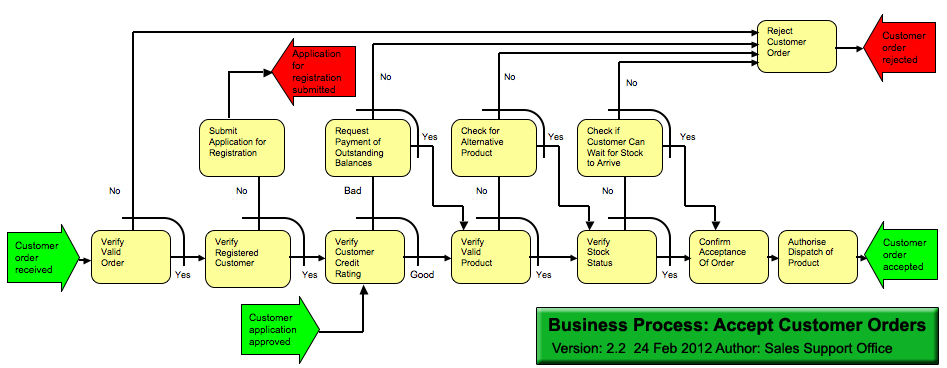
Business Process Diagram for 'Accept Customer Orders'

The essential stages in Business Process Modeling are:

  • Build the Function Catalogue.
  • Identify what Business Processes the business requires to be modeled.
  • For each Process:
    • Identify and define the Process Objective – no objective means no Process!
    • Identify and document all Triggers that could start this process.
    • Identify and document the Preferred Outcome(s).
    • Identify, document and rank all Non-Preferred Outcomes.
    • Identify the Business Functions needed to take the process from the Trigger(s) to each of the Outcomes.
    • Identify and map the precedence between Business Functions.
    • Draw the Business Process.

All you will ever need to know about business process modeling is contained in the IMM™ Business Process Modeling eBook from our  Online Store.

2 Responses to “Business Process Modeling”

  1. Putcha V. Narasimham May 24, 2012 7:40 am #

    Dear John Owen:

    Good and crisp text (sorry the diagram is too small and enlargement has smudged).

    I am glad to find non-preferred outcomes. I suppose they would include possible byproducts, undesirable outputs (like effluents in chemical processes, noxious wastes).

    I have not found Process Facilities and Consumables and Feedback from receiver processes. They need to be identified for a full description of a process.

    Good wishes,

    kenablersys@yahoo.com

    • John Owens May 31, 2012 1:40 am #

      Hi Putcha

      Thank you for your feedback.

      Non-preferred outcomes are not undesirable outcomes like the ‘noxious wastes’ that you referred to.

      They are acceptable outcomes that harm neither the customer nor the business and leave both in a healthy state.

      They are called ‘Non-Preferred’ simply because they do not end up at the Preferred outcome, say, of “Order Accepted”.

      Knowing and modelling Non-Preferred outcomes prevents ‘Noxious’ outcomes. These are outcomes that can harm the business and its relationship with the customer, for example, leaving a process uncompleted with neither the customer nor the business knowing where it stands and what happens next.

      Incidentally, I have replaced the ‘fuzzy’ diagram with a new crisp example. Have a look and see what you think.

      Regards
      John

Leave a Reply